
Progressive Deep Drawing Solutions for Precision Metal Parts
Progressive deep drawing is an advanced metal forming process that combines deep drawing technology with a progressive die system. Manufacturers usually use this process to produce complex, high-precision metal components in high volumes. Many industries, including automotive, electronics, medical devices, and industrial equipment manufacturing, rely on this method. At Stamping Vietnam, we specialize in custom progressive deep drawing solutions. Our services ensure dimensional accuracy, consistent quality, and cost-effective mass production for both simple and highly
What Is Progressive Deep Drawing?
Progressive deep drawing is a sheet metal forming method where a metal strip is gradually shaped through multiple stations within a single progressive die. Each station performs a specific operation such as:
- Blanking
- Punching
- Pre-forming
- Deep drawing
- Ironing
- Trimming
As the metal strip moves continuously through the die, each stage progressively transforms the flat blank into a three-dimensional hollow component with precise geometry. This integrated workflow significantly improves production efficiency and repeatability compared to traditional single-stage deep drawing processes.

How Progressive Deep Drawing Works
The process begins with a coil of sheet metal that is automatically fed into a progressive stamping press. The strip moves step-by-step through multiple die stations, with each stroke of the press completing one stage of forming. Key stages include:
Material Feeding
The process begins with automated feeding of a metal coil into the progressive die system, ensuring stable and continuous production flow.
- Sheet metal is uncoiled and leveled to remove internal stress
- Servo or mechanical feeder controls precise pitch feeding
- Proper lubrication is applied to reduce friction and tool wear
- Alignment systems ensure accurate strip positioning
This stage is critical because stable feeding directly impacts dimensional accuracy in all subsequent forming steps.
Sequential Forming Operations
The strip moves through multiple die stations, where each station performs a specific transformation to gradually shape the material.
- Initial blanking defines the part geometry and removes excess material
- Piercing operations create holes or reference features
- Pre-forming bends or shapes the material to reduce forming stress
- Intermediate stations refine geometry before deep drawing
Each step is carefully designed through die simulation to prevent defects such as tearing or excessive thinning.
Deep Drawing Stage
In this key stage, the flat sheet metal is pulled into a die cavity to form deep or hollow geometries while maintaining structural integrity.
- Punch forces the material into the die cavity under controlled pressure
- Blank holder regulates material flow to prevent wrinkling
- Material thickness distribution is optimized to avoid weak points
- Multi-draw operations may be used for deeper or more complex shapes
This stage determines the final depth, wall quality, and mechanical strength of the component.
Final Trimming and Ejection
Once the part reaches its final shape, the system separates it from the strip and prepares it for downstream processes or assembly.
- Excess material (flash) is trimmed to achieve the final dimensions
- The finished part is automatically ejected from the die
- Scrap skeleton is collected or rewound for recycling
- Optional secondary operations, like deburring or surface treatment, may follow
This ensures a clean, production-ready component with minimal manual intervention.
Advantages of Progressive Deep Drawing
Progressive deep drawing offers significant advantages for manufacturers looking to achieve high-volume production with consistent quality, reduced cost, and superior part performance.
- High production efficiency: Continuous strip feeding combined with multi-station forming significantly reduces cycle time, making it ideal for mass production environments.
- Excellent dimensional accuracy: Each forming stage is precisely controlled within the progressive die, ensuring tight tolerances and consistent part geometry across large batches.
- Reduced material waste: Optimized strip layout and nesting design minimize scrap generation, helping manufacturers improve material utilization and cost efficiency.
- High repeatability and stability: Automated progressive stamping ensures stable production conditions, reducing human error and maintaining consistent quality over long production runs.
- Capability for complex geometries: The multi-step forming process produces deep, intricate, and thin-walled components. Single-stage processes cannot easily produce these complex parts.
- Lower labor and operational cost: Once the die is set up, the process requires minimal manual intervention, reducing labor dependency and overall manufacturing cost.
Common Applications
Progressive deep drawing is widely used across multiple industries:
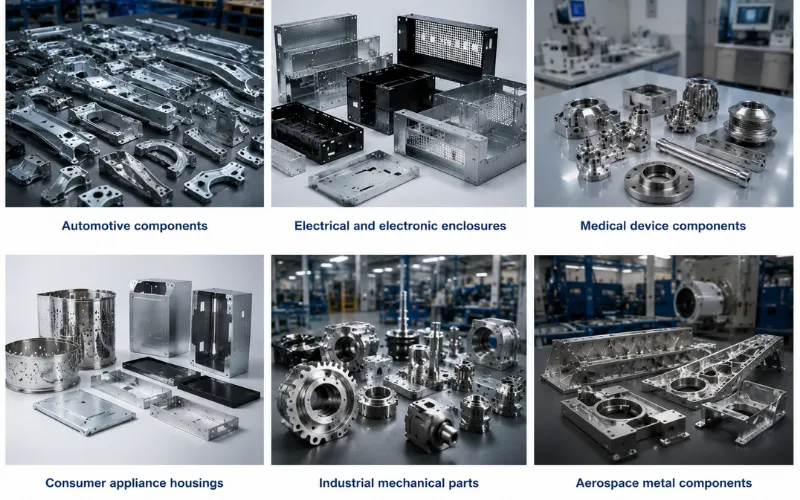
Its ability to produce lightweight yet strong components makes it a preferred solution for modern engineering designs.
Engineering Capability at Our Company
At Stamping Vietnam, we provide engineering support for the entire progressive deep drawing development cycle. Our services cover design validation, prototyping, and mass production. Our mission is to help global customers maintain stable quality and improve manufacturing efficiency.
- Custom progressive die design and engineering: Our engineering team designs progressive dies based on part geometry, material properties, and production volume requirements to ensure optimal forming performance and tool life.
- CAE simulation and forming analysis: We utilize advanced simulation tools to predict material flow, thinning, wrinkling, and potential defects before tooling fabrication, reducing development risk and cost.
- Precision tool manufacturing and try-out: High-accuracy machining and controlled die try-out processes ensure that tooling meets tight tolerances and performs consistently in real production conditions.
- High-speed progressive stamping production: We operate high-tonnage presses capable of stable continuous production, ensuring efficiency for both medium and high-volume manufacturing needs.
- Quality inspection and process control: We implement dimensional inspection, SPC monitoring, and in-process quality checks to guarantee consistency and compliance with customer specifications.
- Material optimization and cost engineering: We support material selection and strip layout optimization to reduce waste, improve formability, and achieve cost-effective production solutions.
These integrated engineering capabilities allow us to deliver reliable, scalable, and technically optimized progressive deep drawing solutions for demanding industrial applications.
Why Should You Choose Stamping Vietnam?
We are a trusted manufacturing partner for global OEMs seeking high-quality progressive deep drawing and metal stamping solutions with strong engineering support and stable production capability.
- Advanced progressive die technology: We invest in modern die design techniques and manufacturing systems to ensure high precision, long tool life, and stable forming performance.
- Reliable mass production capability: We design our production system for scalability, which allows us to handle both small batches and large-volume production with consistent quality.
- Competitive manufacturing cost advantage: Located in Vietnam, we offer cost-efficient manufacturing solutions without compromising on technical quality or engineering standards.
- Strict quality assurance system: We control every stage from incoming material inspection to final product inspection under a structured QA system to ensure a zero-defect mindset.
- Experienced engineering and technical team: Our engineers have extensive experience in progressive stamping and deep drawing applications across automotive, electronics, and industrial sectors.
- Customer-oriented development support: We work closely with customers from early design stages to optimize manufacturability, reduce cost, and accelerate time-to-market.
We bring together strong engineering expertise, advanced progressive tooling capabilities, and a strict quality-first production system. The team supports your most demanding deep drawing projects from concept through mass production. Contact us today to discuss your requirements and get a fast, engineering-driven solution tailored to your project needs.
FAQs
Yes. We provide engineering support from design review and simulation to tooling and mass production
We apply a strict quality control system throughout the entire process, including material inspection, in-process checks, and final dimensional verification. In addition, we use SPC monitoring and precision measuring equipment to ensure every batch meets customer specifications consistently.